
Future Directions & Research Vision
Advancing expert modeling through AI augmentation, richer data integration, and next-generation behavioral simulation
Research Vision
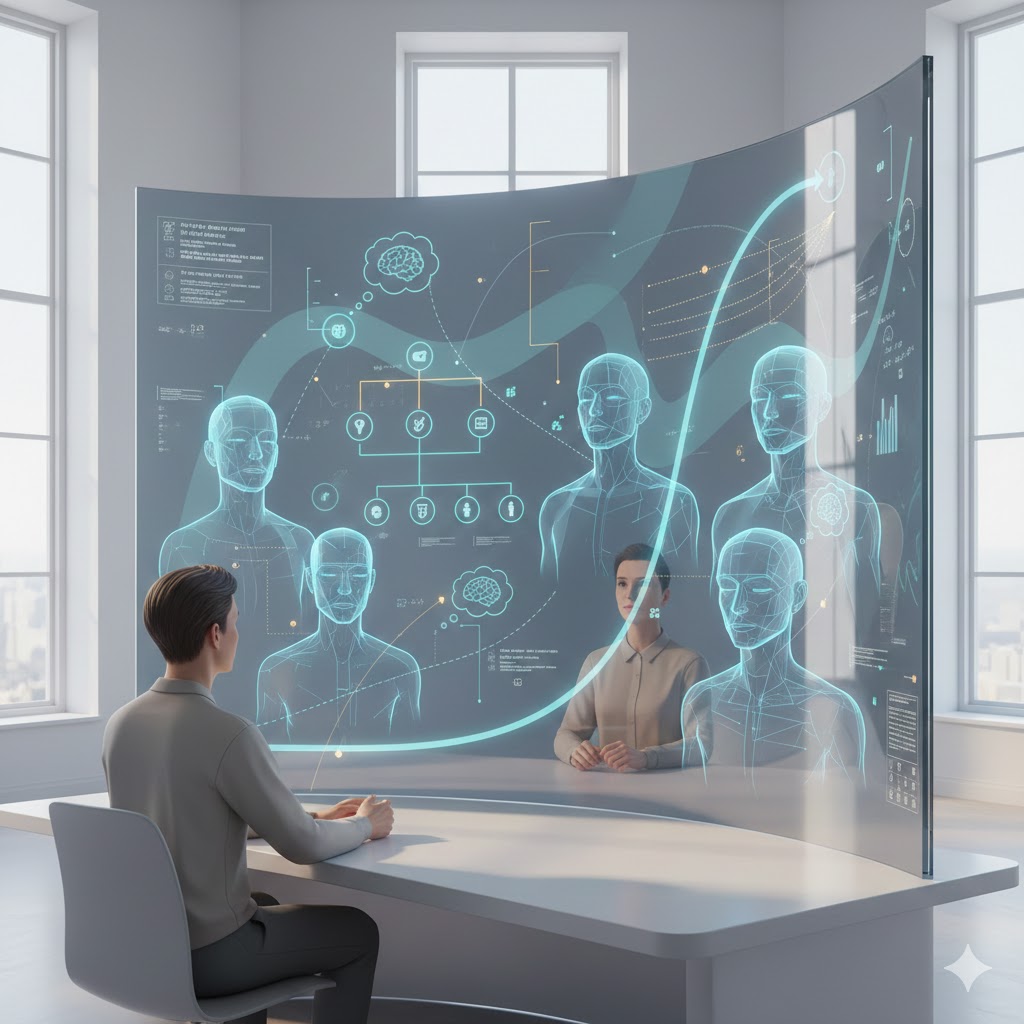
Our future work builds on a mature foundation of expert modeling, behavioral science, and decision analysis under uncertainty. We develop models from scratch when problems demand bespoke solutions, and we leverage generative AI to accelerate development, enhance behavioral realism, and explore counterfactual scenarios more rapidly.
The emergence of large language models creates unprecedented opportunities for behavioral simulation—but requires rigorous validation to ensure outputs remain grounded in empirical data and sound theory. Our competitive advantage lies in combining AI acceleration with 20+ years of domain expertise to deliver both speed and trustworthiness.
We focus on three strategic directions: (1) integrating AI-powered generative agents into agent-based models for unprecedented behavioral realism, (2) synthesizing large-scale data through AI-assisted methods, and (3) extending proven modeling platforms into new domains and crisis scenarios.
Extending Existing Modeling Platforms
Tax Evasion & Compliance Dynamics
We plan to expand our behavioral tax evasion models by leveraging existing agent-based and network-based frameworks. Future work will explore richer heterogeneity in taxpayer behavior, social influence mechanisms, enforcement strategies, and adaptive expectations—allowing us to analyze compliance dynamics under changing economic conditions and policy regimes.
Health Insurance & Labor Markets
Building on established microsimulation models of health insurance markets and employment, we aim to analyze supply and demand for health care workers under stress conditions such as pandemics, economic shocks, and policy reforms. This includes modeling entry, exit, burnout, and occupational switching within the health workforce.
Crisis-Driven Economic Behavior
Across domains, we are interested in how crises reshape incentives, risk perceptions, and behavioral norms. Future extensions will explicitly couple economic behavior to epidemiological, institutional, and informational dynamics.
Synthetic Populations, Data Integration & Networks
A core methodological direction is the development of richer synthetic populations that merge multiple large-scale datasets—demographic, economic, financial, and health—into coherent individual-level representations.
- Iterative proportional fitting and related methods to match multiple marginal distributions
- Multi-scale population representations (national, state, local)
- Assignment of individual attributes across domains (demographics, income, employment, health)
- Generation of interaction networks capturing daily contacts, economic ties, and social structure
- Scenario-dependent interaction modes (normal conditions vs. crisis behavior)
These synthetic populations and networks serve as critical inputs to agent-based and microsimulation models, enabling more realistic and policy-relevant simulations.
Large Language Models as Behavioral Personas
Large language models enable a qualitative leap in behavioral realism for agent-based models. Rather than simple rule-based agents, we can create survey-calibrated personas that reproduce nuanced human decision-making—validated against empirical data and expert judgment. This capability positions us at the frontier of computational social science.
Survey-Calibrated Personas
We aim to train and calibrate large language models on rich longitudinal survey data to create behavioral personas that reproduce observed responses, beliefs, and decision-making patterns across different subpopulations.
Counterfactual & Rapid Insight
Once calibrated, these personas can be used to explore sophisticated counterfactual questions—providing early insight into how different groups might respond to novel policies or emerging crisis conditions before new surveys are fielded.
Coupling Simulation with AI
Outputs from LLM-based personas can directly inform agent-based and dynamical models, allowing behavioral assumptions to evolve alongside system dynamics in a tightly coupled framework.
Expert Modeling in the Age of AI
AI tools can accelerate model development, generate code, and prototype solutions rapidly. But high-stakes policy modeling requires what AI cannot provide: judgment about model structure, behavioral plausibility, and appropriate use of uncertainty.
We integrate AI throughout our modeling workflow—using it to accelerate routine tasks like code generation, data synthesis, and sensitivity exploration—while applying domain expertise to design model structures, validate outputs, and ensure behavioral plausibility. Every model, whether entirely hand-crafted or AI-augmented, undergoes rigorous expert validation before informing policy decisions.
This synthesis—expert modeling augmented by AI, validated through experience—represents the future of policy analysis. We don't choose between human expertise and AI capability; we integrate both.
Complex Systems & Financial Dynamics
Beyond specific application domains, we are interested in using modern AI and data-driven methods to extract structure, mechanisms, and regularities in complex adaptive systems.
- Learning reduced-form dynamics from high-dimensional simulation output
- Identifying universality and phase transitions in social and economic systems
- Applying network and agent-based methods to financial data and markets
- Integrating empirical market data with behavioral and institutional models
Looking Ahead: Expert Modeling, AI-Accelerated
Our future work combines proven modeling expertise with cutting-edge AI capabilities. We build models from scratch when needed, leverage AI when appropriate, and always validate with 20+ years of domain experience. The result: faster insights without sacrificing the rigor and trustworthiness essential for high-stakes policy decisions.